
ACM source attribution: Complete full-text transcription from ACM publisher HTML, cross-checked against the supplied 7-page proceedings PDF. DOI: 10.1145/3648188.3675145.
Uncovering Peer Production's Homogeneity: A Synthesis of Serious Information and Entertainment
Authors: Siyu Zhang , Sichuan International Studies University, China, zsyalicia@163.com
Abstract
Within the realm of peer production, this study explores whether individuals are inclined to generate entertainment content or serious information, and whether these forms of content creation are in competition. The analysis encompassed 315,916 articles edited by 8,551 editors on Baidu Baike, a platform analogous to Wikipedia. Utilizing a pre-trained neural network language model, the articles were categorized to discern editorial preferences in content modification. Social network analysis and fixed effects models illuminated consistent patterns in individuals’ propensities toward diverse content editing behaviors, underscoring the interplay between entertainment and serious content production. These findings deepen our understanding of users’ preferences and motivations in content creation and editing, while also contributing to our insights into the actors involved in science and health communication initiatives.
CCS Concepts
CCS Concepts: • Human-centered computing → Empirical studies in HCI ;
Keywords
peer production , editors overlap , online communities
ACM Reference Format
ACM Reference Format: Siyu Zhang. 2024. Uncovering Peer Production's Homogeneity: A Synthesis of Serious Information and Entertainment. In 35th ACM Conference on Hypertext and Social Media (HT '24), September 10-13, 2024, Poznan, Poland . ACM, New York, NY, USA, 10 Pages. https://doi.org/10.1145/3648188.3675145
1 INTRODUCTION
Numerous studies have explored collaborative production editing patterns; however, the focus on specific content types produced within such settings has been limited. This gap is significant since collaborative production is key to public knowledge dissemination. The propensity of contributors to favor certain information types could significantly alter the landscape of information distribution. This research examines whether editors on a peer-produced encyclopedia platform show preferences in producing different types of content, specifically serious and entertainment content, and examines the dynamics of participant contributions within these categories. Additionally, the study assesses the impact of positive reinforcement within the online community on participant contributions.
To investigate these research questions, we first employed a pre-trained neural network language model to classify all articles edited by participants into 12 types and analyzed their involvement in generating these types. We then further categorized these 12 types into serious information and entertainment content, examining the relationship between them. Utilizing a fixed effects model, we also explored the predictability of editors’ future editing behavior based on their past editing patterns and the rewards they received.
Our findings reveal a consistent pattern in the production of various information types, demonstrating a link between entertainment and serious content editing. Counterintuitively, editors who engage more in producing entertainment content also tend to increase their contributions to serious information. However, we found that past editing history and the number of likes received for edited articles do not reliably predict future editing productivity.
These insights provide a deeper understanding of online communities, revealing complex interrelations between content production categories and the motivations behind editing actions. This knowledge not only enhances our understanding of online community dynamics but also offers valuable perspectives for optimizing collaborative production processes.
1.1 Editing patterns and Audience Fragmentation
Research on Wikipedia's editing patterns can be bifurcated into two primary domains. The first domain investigates editor behavior at the collective level, scrutinizing how collaborative efforts among editors’ shape editing patterns and the relationship between editors’ collective identity and their editing behaviors. For example, Liu and Ram [1] and Yu et al. [2] have explored this dimension. Additionally, the correlation between editors’ sub-group identity and the sustainability of online communities has been investigated. Zhu et al. [3] analyzed data from 5673 Wikia communities, finding that those with substantial member overlap tend to have higher survival rates.
The second domain concentrates on individual editors’ editing practices, including variations in the number of articles editors participate in over time. Bryant et al. [4] noted that novice editors often engage with familiar topics, while expert editors contribute across a wider range of subjects and assume various production roles. Priedhorsky et al. [5] found that a minority of editors are responsible for the majority of editing activity. Iba et al. [6] further categorized editors and examined the behavioral traits of top contributors. Furthermore, studies have probed how Wikipedia influences editors’ topic involvement [4]. Keegan et al. [7] revealed that editors’ prior experiences and the attributes of their previously edited articles influence their editing practices.
However, the existing literature has largely neglected individual editors’ editing preferences, particularly whether editors demonstrate a propensity to edit specific types of articles. To advance collaborative content production research, a more nuanced approach is necessary to transcend the current broad categorizations. Notably, current research is narrowly scoped, primarily focusing on breaking news and limited article genres [7,8].
This study aims to bridge the research gap by drawing on the concept of “audience fragmentation” from communication studies. This concept refers to the proliferation of information and digital advancements that empower individuals to selectively consume preferred media content while ignoring others. This selective consumption results in audience fragmentation, where audiences who previously consumed diverse media content transition to consuming only a single type [9].
Exploring the factors contributing to audience fragmentation, researchers have proposed two primary perspectives: ideology-driven and interest-driven. These perspectives collectively illuminate the phenomenon of audience fragmentation. The ideology-driven perspective suggests that individuals gravitate towards information that aligns with their political beliefs and attitudes, fostering a trend of consuming media shared by like-minded individuals [10]. This tendency leads individuals to curate an information environment that reflects their own perspectives, thereby exacerbating audience fragmentation. Conversely, the interest-driven perspective posits that in the era of abundant media options, viewers can easily opt for content tailored to their personal interests. For instance, some may prefer celebrity news or sports coverage, while others may actively avoid serious information and indulge in their preferred genres [11].
These two viewpoints provide an explanatory framework for audience fragmentation, indicating that individuals often encounter highly personalized and distinct information environments [12,13]. Additionally, the agenda-setting theory posits that mass media can shape individuals’ perceptions through the information it disseminates [14].
Given this context, this study investigates whether producers in collaborative production communities are susceptible to similar influences. Keegan [15] noted significant shifts in editing behavior following external events like COVID-19. We hypothesize that editors in online encyclopedia communities may be swayed by the content they consume when editing articles, suggesting that producers are more inclined to edit articles that they engage with. If this hypothesis holds true, we might observe a differentiation in content types among producers. For instance, if producers predominantly consume entertainment content, they may focus on editing entertainment articles, and vice versa.
Therefore, this study seeks to determine whether producers in collaborative production communities exhibit a convergence in content types or differentiate based on their consumed information.
Research Question One: Is there a convergence among editors in terms of the different content types of articles they edit?
1.2 The distinction between serious information and entertainment knowledge
Studies have hypothesized that, given the finite attention and time individuals allocate to media consumption, news and entertainment vie for viewer engagement. Nevertheless, this hypothesis encounters challenges in practical scenarios. Recent studies by Lelkes [17] and Huang and Yang [18] et al. contest this notion. They argue that with the fluidity of individuals’ online time, there may not be a need to weigh content types against each other. Their research suggests that the availability of diverse entertainment options with high-speed Internet connectivity leads to an increase, rather than a decrease, in absolute news consumption.
In the context of collaborative knowledge production, where efforts differ from entertainment, personal investment is crucial. Consequently, the study posits that editors’ production time is limited. The central question, therefore, is whether allocating more time to entertainment content production detracts from engagement in serious information creation. Research Question Two thus arises:
Research Question Two: Does the production of serious information compete with entertainment content for editor engagement?
Furthermore, the sustainability of online communities depends on continuous member engagement and knowledge exchange [10], which are of significant value to large-scale language models that frequently utilize these platforms as primary sources [19,20]. Various factors impact productivity and retention within online production communities, including leadership behaviors [21], interactions between new and existing members [22], feedback mechanisms [3], and community membership overlap [23].
Building on the concept of social facilitation [24], Ling et al. [25] provide insights into their findings. Social facilitation posits that individuals may increase their contributions to communities when they perceive their input is evaluated by peers. Arazy's research suggests that positive feedback on one's contributions significantly influences sustained engagement, while negative feedback also has a notable effect [26]. Cheshire and Antin [20] emphasize the importance of gratitude and comparative contribution ranking in enhancing the social and psychological gratification of continued contributions. Restivo and Rijt [27] awarded editorial honors to a select group of top 1% Wikipedia contributors, leading to a 60% increase in productivity compared to a control group. Ultimately, this study aims to empirically evaluate the production volume and the impact of encouragement on contributors in real-world scenarios, addressing the following research questions:
Research Question Three: Can the number of likes received by editors’ contributions serve as a motivational force for their engagement in content production? If so, does this motivational effect differ across editors’ various content production categories?
2 METHODOLOGIES
2.1 Data Collection
At the outset of the study, we referred to the tutorials provided by Baidu Baike, which guide beginners in editing articles across 19 genres.These tutorials offer example articles for reference. We then conducted a random selection process, choosing 10 sample articles from each category within the tutorials, resulting in an initial sample set of 190 articles. Baidu Baike meticulously records editors’ details for each article, including editor identifiers and timestamps of contributions. We compiled a comprehensive list of all contributors involved in editing these articles, totaling 8,551 editors, which served as our definitive sample for the investigation. The consolidation of editing logs for these editors, encompassing article titles, descriptions, timestamps of edits, and editors’ hierarchy levels, yielded a dataset of 315,916 articles edited by all authors (for a detailed breakdown of data distribution, see supplementary materials Tables A3 and Figure A4).
Due to the lack of distinct operational guidelines for the nineteen designated types and the non-categorized nature of all Baidu Baike articles, potential overlap among different article categories may exist. To address this, we proposed a novel classification system, categorizing articles into 12 distinct genres, including education, business and economics, politics and diplomacy, scientific knowledge, internet and engineering technology, sports, location and transportation, medical health, entertainment, customs and culture, social phenomena, and history (for a detailed codebook, refer to the supplementary materials Table A1).
Utilizing the Chinese pre-trained BERT WWM model, an enhanced variant of the original BERT model based on Whole Word Masking technology, we employed the full word masking (WWM) method to alleviate the constraints associated with conventional masking approaches that only obscure partial word fragments. Through WWM, if any component of a word is masked, the entire word is hidden conjointly, ensuring the holistic concealment of the word. This strategic approach enhances the model's ability to predict complete words, with BERT WWM demonstrating improved predictive efficiency compared to the base BERT model [28].
To initiate the analysis, we randomly sampled 2,000 articles from the pool of 315,916 article logs. Following categorization according to the coding schema, the pre-classified articles were divided into training, validation, and testing cohorts. To further enhance the BERT-WWM model, we integrated a classification layer incorporating the softmax function atop the model (for detailed model precision, refer to the supplementary materials Table A2). Following fine-tuning, all 315,916 articles were classified using the refined BERT model adaptation.
2.2 Analyzing Strategy
Research Question One, we utilize the social network analysis method [29] to examine potential fragmentation in editors’ editing behaviors across different article categories. By treating distinct content types as nodes and editors’ contributions across genres as edges, this method addresses the central question of whether editors show homogeneity across diverse types of articles. If homogeneity exists, substantial interconnections between nodes would be lacking. In line with previous scholarly studies [18,29], a thresholding procedure was implemented to eliminate nonsignificant editor overlaps, thereby reducing random noise and enhancing the precision of our analysis.
In Research Question Two, we sought to identify the potential competitive relationship between editors in producing serious information and entertainment content. To accurately analyze this competitive relationship, we conducted a correlation study on editors’ articles across distinct content categories. Subsequently, to address time constraints, external stimuli, and other potential confounding variables that could influence editors’ preferences, we utilized a fixed effects model for regression analysis.
begin{equation} {S}_{it} = {D}_t + {C}_i + beta times {E}_{it} + {e}_{it} end{equation}
(1)
Within the fixed effects model, we incorporated the fixed effects of user levels, denoted as$ {C}_i$ , to encapsulate the constancy of individual attributes like editor’ identity and educational background. This methodology enables us to uncover the genuine link between editors regarding the creation of serious information and entertainment content, devoid of disturbances from these fixed elements. In this context, ${S}_{it}$ represents the number of serious information articles edited by editor i during time unit t, ${E}_{it}$ signifies the number of entertainment content articles edited by editor i during time unit t, ${D}_t$ denotes the time unit dummy variable.
begin{equation} {N}_{it + 1} = {D}_t + {beta }_1 times {N}_{it} + {beta }_2 times {L}_{it} + {C}_i + {beta }_3 times {N}_{it} times {L}_{it} + {e}_{it} end{equation}
(2)
Within this model, ${N}_{it + 1}$ represents the count of articles produced at t+1 per unit time, ${N}_{it}$ represents the count of articles produced at t per unit time, ${L}_{it}$ conveys the count of likes garnered by editor i per unit time t, ${N}_{it} times {L}_{it} $ the potential interaction effect between article numbers and likes in the time unit t , ${D}_t$ denotes the time unit dummy variable, ${C}_i$ signifies the individual-level fixed effect. Through this systematic approach, the research endeavors to unravel the influence of prior articles edited and likes received by editors through editing these articles in the preceding time frame on the forthcoming production quantity.
3 FINDINGS
Prior to delving into the research question, we conducted an analysis on the correlation between editors' tenure and the categories of content they engage with. Past research suggests that as editors gain experience, their editing scope broadens to encompass a diverse array of article types [4,5]. The editors’ level on Baidu Baike reflects an editor's contribution to the platform, where higher levels signify more editing records and higher-quality editing endeavors. Employing Entropy to compute the diversity index of content genres for each editor's editing history, we conducted a one-way analysis of variance on Baidu Baike editors’ information entropy across varying levels. The LSD post hoc comparative analysis revealed no significant disparity in content editing between editors at different levels (refer to the supplemental material Table A5 for entropy formula and calculation outcomes). This analysis indicates an absence of correlation between editor seniority and content production genres, thus directly endorsing the validity of our research inquiry.
In tackling research question one, we applied a social network analysis approach and observed 12 nodes interconnected by 65 edges. As depicted in Figure 1, the presence of editor overlap within the network is notable. The network manifests high density and strong interconnections, evidenced by a specific density and an average clustering coefficient of 0.985, characterizing it as a densely overlapping social network [30]. Comparative analyses with prior studies on audience overlap like news contact [30] and news consumption [18] confirm that the network among editors’ production in various genres is a unified network without distinct segmentation.
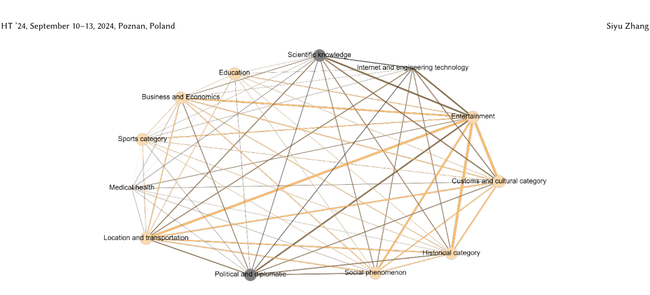
Figure 1: Peer overlap networks between categories after dyadic thresholding. (Note: The sizes of nodes and the width of edge referred to the number of unique editors who edit on one category of articles represented by one node, and the number of unique editors who edit on both categories of articles linked by one edge. The color referred to the serious information (grey)/ entertainment (yellow) dichotomy. See Supplemental Table A1 for more details.)
In relation to research question two, which investigates the presence of a competitive dynamic between the production of serious information and entertainment content, we initially conducted a Pearson correlation analysis between the 12 categories in pairs. Specifically, we scrutinized whether an editor's output in one category correlates with their output in other categories. The outcome of the Pearson analysis, as depicted in Figure 2, revealed significant correlations for all pairs at p<0.05, suggesting that editors do not engage in competition when generating diverse content types.
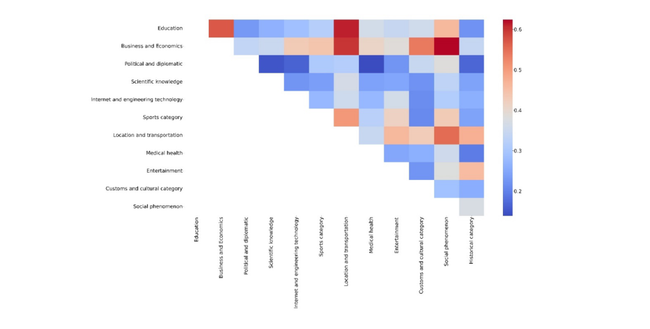
Figure 2: Associations between the number of articles edited of one category and that number for the other category(Note: All associations are positive.)
To further delve into the interplay between editors and the creation of distinct article types, we categorized the 12 Baidu Baike article categories into two groups: serious information and entertainment content. The serious information category encompasses scientific knowledge, internet and engineering technology, medical and health, and political diplomacy, while the remainder fall under entertainment content. While recognizing the categorical breadth inherent in this classification, it captures the core of editors’ intellectual endeavors. The creation of serious content requires a particular professional expertise, which distinguishes it from the more pedestrian entertainment offerings prevalent in mainstream media and readily accessible to editors. Utilizing a fixed effects model, we analyzed the correlation between the production of serious information and entertainment content by individuals over a one-month and twelve-month duration. The outcomes, detailed in Table 1, revealed that the production of entertainment content positively associates with the production of serious information. For each additional unit of entertainment content, serious information output increases by 0.1450 units. The negative coefficient of the time dummy variable signifies a decline in the production of serious information over time.
Table 1: Fixed-effects model identifying relationship between entertainment and serious information production
Time unit | Variable | Parameter | Std. Err. | T-stat |
1-month unit | Entertainment production | 0.145*** | 0.0027 | 53.966 |
Time | -0.0043* | 0.0014 | -3.0359 | |
12-month unit | Entertainment production | 0.203*** | 0.0042 | 48.719 |
Time | -0.0069* | 0.0031 | -2.2679 | |
a. ***p < .001, *p < .05. The dependent variable for all models was the number of serious knowledge articles edited by individual editor. --- |
Our study underscores the absence of editor fragmentation in peer production; editors engaged in professional and entertainment articles exhibit a notable level of similarity. Concurrently, we delved into research question three, probing whether the number of edited articles and likes received through these editing articles in one time unit hold predictive value for their subsequent editing activities. The findings (as outlined in Table 2) indicate that neither past editing history nor the number of likes significantly impact editors' future editing endeavors. Moreover, we analyzed editors' production of serious information and entertainment content in the current period compared to the following time unit (refer to Table 3). The data reveals that editors past editing patterns in entertainment or serious information, as well as likes, do not serve as reliable predictors of the volume of entertainment or serious information in the subsequent period.
Table 2: Fixed-effects model identifying relationship between likes and previous output on current production
Time unit --- | Variable | Parameter | Std. Err. | T-stat | P value | |
1-month unit | Previous editing numbers --- | -6.00E-03 | 8.53E-02 | -7.05E-02 | 9.44E-01 | |
Previous likes --- | -8.39E-06 | 5.16E-05 | -1.63E-01 | 8.71E-01 | ||
Previous editing numbers *Previous likes --- | 1.24E-07 | 1.14E-07 | 1.09E+00 | 2.75E-01 | ||
12-month unit | Previous editing numbers --- | 1.62E-02 | 8.74E-02 | 1.86E-01 | 8.53E-01 | |
Previous likes --- | 4.77E-05 | 3.09E-05 | 1.54E+00 | 1.23E-01 | ||
Previous editing numbers*Previous likes --- | -4.88E-08 | 3.11E-08 | -1.57E+00 | 1.17E-01 |
Table 3: Fixed-effects model identifying relationship between likes and previous output on current production
outcome variable: current editing numbers on entertainment(e) --- | |||||
Time unit | Variable | Parameter | Std. Err. | T-stat | P value |
1-month unit | Previous editing number(e) | -2.58E-02 | 8.17E-02 | -3.15E-01 | 7.53E-01 |
Previous likes | -2.28E-05 | 3.78E-05 | -6.03E-01 | 5.47E-01 | |
Previous editing numbers(e)*Previous likes | 1.62E-07 | 9.42E-08 | 1.72E+00 | 8.52E-02 | |
12-month unit | Previous editing numbers(e) | 3.33E-02 | 8.63E-02 | 3.87E-01 | 6.99E-01 |
Previous likes | 2.93E-05 | 2.23E-05 | 1.31E+00 | 1.89E-01 | |
Previous editing numbers(e) *Previous likes | 4.20E-08 | 2.66E-08 | -1.58E+00 | 1.15E-01 | |
outcome variable: current editing numbers on serious information(s) --- | |||||
Time unit | Variable | Parameter | Std. Err. | T-stat | P value |
1-month unit | Previous editing numbers(s) | 7.94E-02 | 1.09E-01 | 7.28E-01 | 4.67E-01 |
Previous likes | 2.61E-05 | 1.37E-05 | 1.90E+00 | 5.78E-02 | |
Previous editing numbers(s) *Previous likes | 2.07E-07 | 1.85E-07 | -1.12E+00 | 2.62E-01 | |
12-month unit | Previous editing numbers(s) | -1.27E-01 | 2.36E-01 | -5.37E-01 | 5.92E-01 |
Previous likes | 1.42E-05 | 1.51E-05 | 9.36E-01 | 3.49E-01 | |
Previous editing numbers(s) *Previous likes | -4.61E-08 | 7.80E-08 | -5.91E-01 | 5.55E-01 |
4 ROBUSTNESS CHECK
In the robustness check session, to assess the validity of our findings, we recategorized serious information into three distinct domains: scientific knowledge, internet matters, and engineering technology, with medical health. Entertainment content encompassed the remaining categories. Notably, “political diplomacy” was excluded due to its relative accessibility compared to the other three categories. This reclassification allowed for a fixed effects regression analysis across two different time units, as detailed in Table 4. The study demonstrates that, even with the exclusion of political diplomacy, the production of serious informational content and entertainment material by editors is mutually reinforcing rather than competitive. This finding underscores the reliability and validity of our research outcomes.
Table 4. Fixed-effects model identifying relationship between entertainment and serious information production
Time unit | Variable | Parameter | Std. Err. | T-stat |
1-month unit | Entertainment production | 0.0631*** | 0.0022 | 28.459 |
Time | -0.0043*** | 0.0013 | -3.3787 | |
12-month unit | Entertainment production | 0.1083 *** | 0.0034 | 31.486 |
Time | -0.0084* | 0.0028 | -3.0551 | |
a. ***p < .001, *p < .05. The dependent variables of all models were the number of serious knowledges articles edited by individual editor. --- |
5 DISCUSSION
Furthermore, previous literature posited that professionals predominantly engaged in scientific and health communication efforts [31], with a focus on professionals like scientists and healthcare practitioners [32]. However, our research uncovers that individuals disseminating entertainment content also disseminate serious information, reshaping and expanding our understanding of professional knowledge dissemination realms.
Our study unveils a lack of significant correlation between previous editing records and received awards through these contributions, contradicting prior research [16, 20]. Prior works highlighted "fun" as a specific motive for content creation [33], while Foote [34] unearthed that founders' primary motivation for creating wiki articles was knowledge dissemination, alongside secondary motivations like learning and enjoyment. Exploring the disconnect between likes and editors’ productivities, we delve into participants' underlying motivations, suggesting that if individuals engage in collaborative production primarily to share knowledge and align with personal interests rather than seeking social validation, the impact of rewards on production zeal diminishes. This revelation accentuates our understanding of the psychological incentives driving participation in collaborative production.
However, there exist limitations in our study. Primarily, the sample size s may not suffice, warranting external validity testing of our research conclusions. Additionally, the coarse classification of content into serious information and entertainment content overlooks nuances in content types. Future research avenues can address these limitations to explore the distinctions in user production across diverse content categories effectively.
REFERENCES
Liu, J., & Ram, S. (2011). Who does what: Collaboration patterns in the wikipedia and their impact on article quality. ACM Transactions on Management Information Systems, 2(2), 1–23. https://doi.org/10.1145/1985347.1985352
Yu, B., Ren, Y., Terveen, L., & Zhu, H. (2017). Predicting Member Productivity and Withdrawal from Pre-Joining Attachments in Online Production Groups. Proceedings of the 2017 ACM Conference on Computer Supported Cooperative Work and Social Computing, 1775–1784. https://doi.org/10.1145/2998181.2998227
Zhu, H., Zhang, A., He, J., Kraut, R. E., & Kittur, A. (2013). Effects of peer feedback on contribution: A field experiment in Wikipedia. Proceedings of the SIGCHI Conference on Human Factors in Computing Systems, 2253–2262. https://doi.org/10.1145/2470654.2481311
Bryant, S. L., Forte, A., & Bruckman, A. (2005). Becoming Wikipedian: Transformation of participation in a collaborative online encyclopedia. Proceedings of the 2005 International ACM SIGGROUP Conference on Supporting Group Work - GROUP ’05, 1. https://doi.org/10.1145/1099203.1099205
Priedhorsky, R., Chen, J., Lam, S. (Tony) K., Panciera, K., Terveen, L., & Riedl, J. (2007). Creating, destroying, and restoring value in wikipedia. Proceedings of the 2007 International ACM Conference on Conference on Supporting Group Work - GROUP ’07, 259. https://doi.org/10.1145/1316624.1316663
Iba, T., Nemoto, K., Peters, B., & Gloor, P. A. (2010). Analyzing the Creative Editing Behavior of Wikipedia Editors. Procedia - Social and Behavioral Sciences, 2(4), 6441–6456. https://doi.org/10.1016/j.sbspro.2010.04.054
Keegan, B., Gergle, D., & Contractor, N. (2012). Staying in the loop: Structure and dynamics of Wikipedia's breaking news collaborations. Proceedings of the Eighth Annual International Symposium on Wikis and Open Collaboration, 1–10. https://doi.org/10.1145/2462932.2462934
Keegan, B., Gergle, D., & Contractor, N. (2011). Hot off the wiki: Dynamics, practices, and structures in Wikipedia's coverage of the Tōhoku catastrophes. Proceedings of the 7th International Symposium on Wikis and Open Collaboration, 105–113. https://doi.org/10.1145/2038558.2038577
Webster, J. G. (2005). Beneath the Veneer of Fragmentation: Television Audience Polarization in a Multichannel World. Journal of Communication, 55(2), 366–382. https://doi.org/10.1111/j.1460-2466.2005.tb02677.x.
Fletcher, R., & Nielsen, R. K. (2017). Are News Audiences Increasingly Fragmented? A Cross-National Comparative Analysis of Cross-Platform News Audience Fragmentation and Duplication. Journal of Communication, 67(4), 476–498. https://doi.org/10.1111/jcom.12315.
Graber, D. A. (2008). Post-Broadcast Democracy: How Media Choice Increases Inequality in Political Involvement and Polarizes Elections – By Markus Prior. Political Psychology, 29(4), 615–617. https://doi.org/10.1111/j.1467-9221.2008.00653.x.
Pariser, E. (2011). The filter bubble: What the Internet is hiding from you. New York, NY: Penguin.
B Borgesius, F. J. Z., Trilling, D., Möller, J., Bodó, B., Vreese, C. H. de, & Helberger, N. (2016). Should we worry about filter bubbles? Internet Policy Review, Volume 5(Issue 1). https://doi.org/10.14763/2016.1.401
McCombs, M., & Shaw, D. L. (2005). The agenda-setting function of the press. The Press. Oxford, England: Oxford University Press Inc, 156-168.
Keegan, B., & Tan, C. (2020). A Quantitative Portrait of Wikipedia's High-Tempo Collaborations during the 2020 Coronavirus Pandemic. ArXiv. https://www.semanticscholar.org/paper/A-Quantitative-Portrait-of-Wikipedia%27s-High-Tempo-Keegan-Tan/7613be16ea35d1b0d221d492f002622c3eee7e8b
Aalberg, T., Blekesaune, A., & Elvestad, E. (2013). Media Choice and Informed Democracy: Toward Increasing News Consumption Gaps in Europe? The International Journal of Press/Politics, 18(3), 281–303. https://doi.org/10.1177/1940161213485990
Lelkes, Y. (2020). A Bigger Pie: The Effects of High-Speed Internet on Political Behavior. Journal of Computer-Mediated Communication, 25(3), 199–216. https://doi.org/10.1093/jcmc/zmaa002
Huang, S., & Yang, T. (2022). No trade-offs between news and entertainment: Evidence from online engagement data. New Media & Society, 14614448211063899. https://doi.org/10.1177/14614448211063899
Chiu, C.-M., Hsu, M.-H., & Wang, E. T. G. (2006). Understanding knowledge sharing in virtual communities: An integration of social capital and social cognitive theories. Decision Support Systems, 42(3), 1872–1888. https://doi.org/10.1016/j.dss.2006.04.001.
Cheshire, C., & Antin, J. (2008). The Social Psychological Effects of Feedback on the Production of Internet Information Pools. Journal of Computer-Mediated Communication, 13(3), 705–727. https://doi.org/10.1111/j.1083-6101.2008.00416.x
Zhu, H., Kraut, R., & Kittur, A. (2012). Effectiveness of Shared Leadership in Online Communities. 407–416. https://doi.org/10.1145/2145204.2145269
Choi, B., Alexander, K., Kraut, R., & Levine, J. (2010). Socialization tactics in wikipedia and their effects. 107–116. https://doi.org/10.1145/1718918.1718940
Chen, J., Ren, Y., & Riedl, J. (2010). The effects of diversity on group productivity and member withdrawal in online volunteer groups. Proceedings of the SIGCHI Conference on Human Factors in Computing Systems, 821–830. https://doi.org/10.1145/1753326.1753447
Zajonc, R. B. (1965). Social Facilitation. Science, 149(3681), 269–274. https://doi.org/10.1126/science.149.3681.269
Ling, K., Beenen, G., Ludford, P., Wang, X., Chang, K., Li, X., Cosley, D., Frankowski, D., Terveen, L., Rashid, A. M., Resnick, P., & Kraut, R. (2005). Using Social Psychology to Motivate Contributions to Online Communities. Journal of Computer-Mediated Communication, 10(4), 00–00. https://doi.org/10.1111/j.1083-6101.2005.tb00273.x
Arazy, O., Liifshitz-Assaf, H., Nov, O., Daxenberger, J., Balestra, M., & Cheshire, C. (2017). On the “How” and “Why” of Emergent Role Behaviors in Wikipedia. Proceedings of the 2017 ACM Conference on Computer Supported Cooperative Work and Social Computing, 2039–2051. https://doi.org/10.1145/2998181.2998317
Restivo, M., & Rijt, A. van de. (2012). Experimental Study of Informal Rewards in Peer Production. PLOS ONE, 7(3), e34358. https://doi.org/10.1371/journal.pone.0034358
Cui, Y., Che, W., Liu, T., Qin, B., & Yang, Z. (2021). Pre-Training with Whole Word Masking for Chinese BERT. IEEE/ACM Transactions on Audio, Speech, and Language Processing, 29, 3504–3514. https://doi.org/10.1109/TASLP.2021.3124365
Mukerjee, S., Majó-Vázquez, S., & González-Bailón, S. (2018). Networks of Audience Overlap in the Consumption of Digital News. Journal of Communication, 68(1), 26–50. https://doi.org/10.1093/joc/jqx007
Majó-Vázquez, S., Cardenal, A. S., & González-Bailón, S. (2017). Digital News Consumption and Copyright Intervention: Evidence from Spain Before and After the 2015 “Link Tax.” Journal of Computer-Mediated Communication, 22(5), 284–301. https://doi.org/10.1111/jcc4.12196
Rödder, S., & Schäfer, M. S. (2010). Repercussion and resistance. An empirical study on the interrelation between science and mass media. Communications, 35(3). https://doi.org/10.1515/comm.2010.014
Schäfer, M. S. (2011). Sources, Characteristics and Effects of Mass Media Communication on Science: A Review of the Literature, Current Trends and Areas for Future Research. Sociology Compass, 5(6), 399–412. https://doi.org/10.1111/j.1751-9020.2011.00373.x
Nov, O. (2007). What motivates Wikipedians? Communications of the ACM, 50(11), 60–64. https://doi.org/10.1145/1297797.1297798
Foote, J., Gergle, D., & Shaw, A. (2017). Starting Online Communities: Motivations and Goals of Wiki Founders. Proceedings of the 2017 CHI Conference on Human Factors in Computing Systems, 6376–6380. https://doi.org/10.1145/3025453.3025639.
Permission to make digital or hard copies of all or part of this work for personal or classroom use is granted without fee provided that copies are not made or distributed for profit or commercial advantage and that copies bear this notice and the full citation on the first page. Copyrights for components of this work owned by others than the author(s) must be honored. Abstracting with credit is permitted. To copy otherwise, or republish, to post on servers or to redistribute to lists, requires prior specific permission and/or a fee. Request permissions from permissions@acm.org.
HT '24, September 10–13, 2024, Poznan, Poland
© 2024 Copyright held by the owner/author(s). Publication rights licensed to ACM.
ACM ISBN 979-8-4007-0595-3/24/09…$15.00.
Do you like what you are reading? Subscribe to receive updates.
Unsubscribe anytime