
Mitigating Bias in GLAM Search Engines: A Simple Rating-Based Approach and Reflection
Xinran Tian (Australian National University, Canberra, ACT, Australia; Xinran.Tian@anu.edu.au), Bernardo Pereira Nunes (Australian National University, Canberra, ACT, Australia; Bernardo.Nunes@anu.edu.au), Katrina Grant (Australian National University, Canberra, ACT, Australia; Katrina.Grant@anu.edu.au), and Marco Antonio Casanova (Pontifícia Universidade Católica do Rio de Janeiro, Rio de Janeiro, Brazil; casanova@inf.puc-rio.br).
Published in HT '23: 34th ACM Conference on Hypertext and Social Media · DOI: 10.1145/3603163.3609043 · License: © Copyright held by the owner/author(s). Publication rights licensed to ACM.
Keywords: GLAM, bias, reflections, search engines
Session: Workflows and Infrastructures
Conference: HT '23
Abstract
Galleries, Libraries, Archives and Museums (GLAM) institutions are increasingly opening up their digitised collections and associated data for engagement online via their own websites/search engines and for reuse by third parties. Although bias in GLAM collections is inherent, bias in the search engines themselves can be rated. This work proposes a bias rating method to reflect on the use of search engines in the GLAM sector along with strategies to mitigate bias. The application of this to an existing large art collection shows the applicability of the proposed method and highlights a range of existing issues.
1 INTRODUCTION
GLAM collections exhibit bias due to a range of collection practices over decades or even centuries that have privileged the collection of art and objects from certain eras, regions, genders and socioeconomic classes [12]. This bias is impossible to eliminate from any search of these collections. However, increasingly scholars and experts from the GLAM sector are calling for more transparency
Bernardo Pereira Nunes Bernardo.Nunes@anu.edu.au Australian National University Canberra, ACT, Australia
Marco Antonio Casanova Pontifícia Universidade Católica do Rio de Janeiro Rio de Janeiro, Brazil casanova@inf.puc-rio.br
and accountability for biases present in digitised cultural collections [9]. Much current work that aims to address bias in GLAM datasets tends to look at the need for diversification of datasets used (adding more diverse works to collections) or for changes to the cataloguing process, including the enrichment of metadata to include more diverse classifications and to reveal contested histories. Both these approaches are worthwhile but require considerable resources and time to undertake. Our proposal is a simple method of addressing existing issues within the search engine design itself that can offer a step towards addressing and revealing bias in search results for the GLAM sector. We do not aim to correct bias — an impossible task for the GLAM sector — but to develop a straightforward rating system where search engine bias can be revealed and addressed, by both developers and end-users. This paper serves as a reflection on the use of search engines in the GLAM sector and offers strategies to address the inherent bias of GLAM collections.
2 RELATED WORK
The problem of bias in datasets and the effect it has on search and other computational applications is well-recognised. Gender [2] and racial bias [1] have been extensively studied by researchers in the AI field. The recognition of bias in GLAM collections, however, requires a level of domain expertise to identify and, even when it is identified, it is still challenging to address for historical and cultural reasons. Biases are further introduced in the process of analogue cataloguing, digitisation and the use of collection management systems [5, 10]. Bias in metadata and categorisation can be created by cataloguers and curators1,2. These biases may include (but are not limited to): vastly different levels of metadata for different types of objects, presentation of object records as objective fact, which obscures debates over origins and meaning, lack of data for certain categories (for example, the gender of artists is rarely recorded), and the use of diverse and idiosyncratic categorisation of objects within individual collections [8, 14]. A recent study of the bias in the Google Arts and Culture platform (GA&C)[9] pointed out that although GA&C includes art from almost every country/region in the UN membership list, its data set is still biased. Museum objects from the United States, the United
1https://bpr.berkeley.edu/2017/05/16/the-conflict-of-curation/ 2https://bookofbadchoices.com/shorts/curation-means-bias/
Kingdom, the Netherlands, Italy and South Korea account for 93.4% of the content posted on the GA&C platform. Srivastava and Rossi (S&R, hence forth) proposed a simple approach to rate bias in the context of text translation using a two-step test [16]. Their approach acts as an independent third-party rating agency controlling the levels of bias in the data input to measure and rate the system bias in the output. This paper extends and applies the rating system proposed by S&R to search engines used in the GLAM sector, a more complex problem. Historical collections of art and material culture contain different kinds of biases that are often different than those typically expected in normal Web search or translation services. GLAM collections are also responsible for perpetuating bias in our society [6]. There is bias in the collection based on decisions about what to add to the collection and in the way collections are displayed (if an art museum chooses to only collect or display works of art by men they perpetuate the bias that men are more creative and important in the art world) [3].
3 OUR SEARCH ENGINE BIAS RATING APPROACH
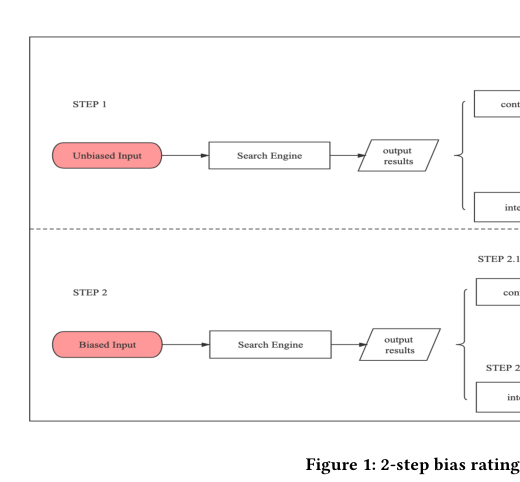
Our approach is an extended 2-step test adapted from the Srivastava and Rossi (S&R) bias rating system to identify bias in the context of text translation [16]. Fig. 1 shows our 2-step approach and each step is explained below.
Step 1: Unbiased Input. The first part of the first step compares the unbiased input with the system’s output. Note that the “unbiased input" for search engines is a known subset of the entire dataset used by the search engine that has no bias with regards to at least one aspect (e.g. gender, region or religion). The bias in the search engine is examined based on the content and interface independently. For content, if the output is deemed to be biased, the system is rated as a “Biased System - Content Bias (BS-CB)". That means the content of the results returned by the search engine are biased according to the aspects under consideration. If the content is deemed not biased, then Step 2.1 is triggered. The same process is carried out for the interface. We will focus on the way search engines present the results to the end-users in the interface analyser instead of the content of all returned results. If the interface presents bias, the system is rated as “Biased System - Interface Bias (BS-IB). Otherwise, Step 2.2 is triggered.
Step 2: Biased Input. As with the S&R approach, we use biased data as input and rate the system based on its ability to deal with the biased input. If the output is deemed to be biased in Step 2.1, then the system has no ability to recover from a biased input and is rated as “Data-Sensitive Biased System - Content Biased (DSBS-CB)". If it is deemed to be biased in Step 2.2, it is rated as “Data-Sensitive Biased System - Interface Biased (DSBS-IB)". If bias is detected neither in Step 2.1 nor in Step 2.2, the original rating “Content Unbiased Compensated System (CUCS)" or “Interface Unbiased Compensated System (IUCS)" is assigned to the results generated by the system demonstrating its ability to remove/compensate content or interface bias in specific subsets generated by the search engine system.
To deal with the complexity of search engine systems, the proposed approach consists of modules similar to those of the S&R approach and a few additional ones. Each module is described below.
The Data Generation module is responsible for generating biased and unbiased data as input based on one or more specific data aspect (i.e., attribute), as explained in Step 1 of our proposed approach. Given an attribute ai∈{a0, ...,an} and a set of keywords (query) q, this module will generate a domain Di= {d0, ...dm} for the attribute aibased on the items related to qfrom the entire dataset used by the search engine. Then, different proportion distributions pare assigned to Dto control the degree of bias of the input, Di= {d0 : pd0, ...dm: pdm}, with Ím k=0 pdk= 1. Finally, for each ai, this module generates a balanced or unbalanced subset on the domain Dibased on its proportion distribution.
The Experiment Setting module decides the clicking model [4, 17] and gives a threshold τ. The clicking model is used to apply weights to the results displayed at different positions in a search engine interface, and tests for interface bias. τis used to set the number of results to be collected and analysed in the interface bias analyser. Only the top Nτresults returned by the search engine will be considered in the interface bias analyser.
The Experiment Executor module automatically runs predetermined queries on the search engine and collects its top Nτoutput results. All of the output results are sent to the content bias analysis module, and the collected results are sent to the interface bias analysis module.
The Content Bias Measurement module computes the data content imbalance for one or more given attributes in the data input. We consider an attribute aiwith its corresponding domain Di= {d0 : p(d0), ...dm: (pm)} in the data generation module. Here, the data imbalance is computed by comparing the distribution of different elements in Di, P(di) = N(Rdi)/Ím j=0 N(Rdj), where N(Rdx) is the number of items related to an elementdxin output results. A new distribution set is computed as Ci= {d0 : P(d0), ...dm: P(dm)}, where diis an element from attribute ai, and P(di) indicates the distribution of diin all output results. By comparing the Ciwith Di, we can compute the bias in the output result content.
The Interface Bias Measurement module calculates the weight for different elements of a given attribute among collected results to check for interface bias. For example, consider an attribute ai with domain Di= {d0, ...dm}, the interface weight for each element in Diis computed as W(di) = Í(weight(Rdi)), where Rdiare all results related to diin top Nτresults, and weight() is the function used to compute the weights for the results displayed at different positions — this is the bases of our clicking model. The output of this module is Ii= {d0 : W(d0), ...dm: W(dm)}. We then compare the weight of different elements to compute the interface imbalance.
The rating and analysing module is finally responsible for aggregating the results and assigning a final bias rating to the search
engine system; the final bias rating includes two parts, one for the content and one for the interface.
4 EXPERIMENTAL SETUP
4.1 Search Engine
To validate our approach, we used the Jina Search Engine3, an open-source deep learning-powered search framework for building multimodal search systems. As Jina is open-source, it can be used as testbed to measure the degree of bias to specific data sets under different algorithms and language models. For our experiments, we used three different language models: Distilbert [15], La BSE [7] and Roberta [11], as required by Jina.
4.2 Dataset
We collected approximately 40,000 resource items from the Metropolitan Museum of Art (MET), Google Images and Baidu Images. The images from Google and Baidu were used to balance or imbalance the existing data in the MET museum collection. We manually built three different subsets resources about Buddha, religious building, and deity/god/goddess respectively from the MET collection, Google, and Baidu, test with five different queries, and use them as input to our system to rate bias on three attributes. These subsets were created to simulate a real search engine used in a GLAM institution. Attribute 1 ‘Origin place of Buddha collection (Region)’ has domain {‘China’, ‘India’, ‘Sri Lanka’, ‘Thailand’} and is tested with query ‘Buddha’; Attribute 2 ‘Religious building (Religion)’ has domain {‘Church’, ‘Mosque’, ‘Temple’, ‘Synagogue’} and is tested with query ‘Place for worship’; Attribute 3 ‘Name of deity/god/goddess’ has domain {‘Jesus’, ‘Nüwa’, ‘Temple’, ‘Synagogue’} and is tested with query ‘God’, ‘Deity’ and ‘Goddess’.
3https://jina.ai
Unbiased input was generated based on distribution pof each element in domain (see Table 1). To generate bias, the proportions of the attribute domains must be asymmetric.
Table 1: Unbiased attribute domain distribution for each attribute in the test set.

Attribute 2 Religious building (Religion)
domain p domain p domain p
China 0.25 Church 0.25 Jesus 0.25
India 0.25 Mosque 0.25 Nüwa 0.25
Sri Lanka 0.25 Temple 0.25 Ptah 0.25
Thailand 0.25 Synagogue 0.25 Brahma 0.25
4.3 Clicking model
We used a simple clicking model approach based on the reading habit of most western countries (top-down and left-to-right reading). The weights to each result were assigned following the formula weight(Resultij) = Nτ−(i+ j), where Nτis the number of results analysed returned by the search engine, and, iand jare the position of an item presented in a grid/matrix. In our experiment, Nτ= 40. The weights are then normalised by W(Rdi)/Ím j=0W(Rdj), where Rdxis defined in the content bias measurement module.
5 RESULTS
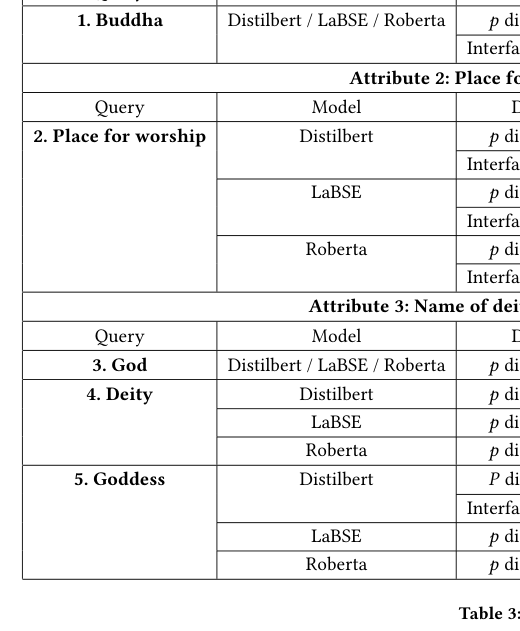
Table 2 presents the results for the three attributes, five queries, and three models described in Section 4. We omit the interface bias for some cases as the content bias is significant (see query 3 and query 4). Table 3 presents rating results based on our experiments. For the first attribute, the bias rating assigned is “BS-IB" for the three models indicating that, with unbiased input (pin Table 2 is equivalent to pin Table 1), the system generates an unbiased content output, but fails in displaying an unbiased list of items with respect to the attribute (imbalanced interface weight). After inspecting the subset used and the metadata descriptions of the resource items, we found that the search engine uses the inclusion date as a sort criterion leading to bias in the interface as resource items were inserted by location batches. As for the second attribute, the bias rating assigned is “BS-CB" indicating that the content generated by unbiased input is biased. The reason is that the output contains imbalanced results for the different places of worship, in this case, “Synagogue" is less represented than “Church" (see pdistribution in Table 2). Note that, if a
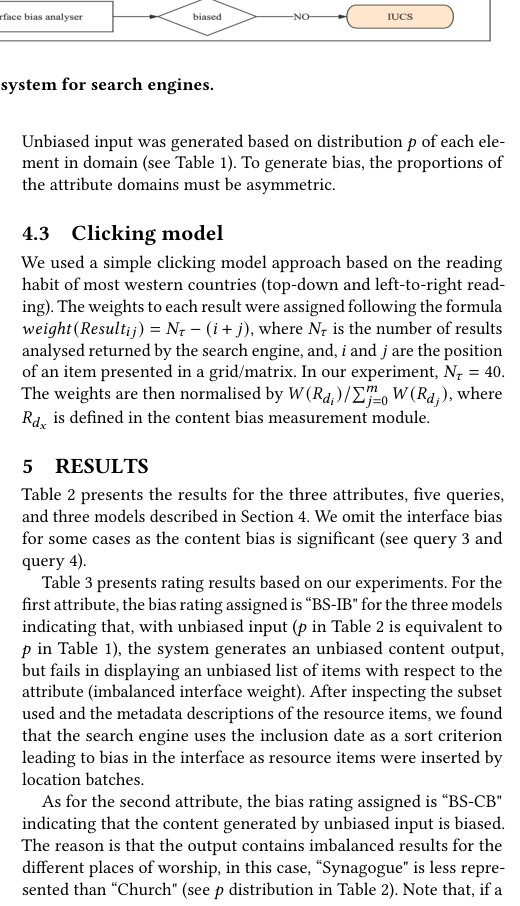
Figure 1: 2-step bias rating system for search engines.
Attribute 1 Origin place of Buddha collection (Region)
search engine is using a language model to retrieve resource items, it must consider the bias added via the language model. For the last experiment, we used three different queries with similar meanings – “God", “Goddess", and “Deity" – on one subset. The results obtained are interesting and worth further investigation, especially in the context of the GLAM sector, as strong biases are identified. According to the results, when using the queries ‘God’ and ‘Deity’, the search engine shows a significant content bias and, therefore, it is rated as “BS-CB". For all three models, the contextual relatedness between ‘God’ and ‘Jesus’ is greater than between ‘God’ and ‘Nüwa’, ‘God’ and ‘Ptah’, and ‘God’ and ‘Brahma’. Here, the language model plays a key role in the bias added to the content; for instance, when using “Deity" as reference, the Distilbert model leans to ‘Brahma’ and La BSE model to ‘Jesus’.
Table 2: Preliminary Results.

Attribute 1: Origin place of Buddha collection (Region)
Query Model Domain China India Sri Lanka Thailand
Buddha Distilbert / La BSE / Roberta pdistribution 0.25 0.25 0.25 0.25
Interface weight W 0.188 0.299 0.311 0.270
Attribute 2: Place for worship (Religion)
Query Model Domain Church Mosque Temple Synagogue
Place for worship Distilbert pdistribution 0.36 0.27 0.27 0.10
Interface weight W 0.392 0.300 0.235 0.073
La BSE pdistribution 0.28 0.28 0.28 0.16
Interface weight W 0.348 0.276 0.237 0.138
Roberta pdistribution 0.33 0.25 0.25 0.16
Interface weight W 0.490 0.269 0.127 0.112
Attribute 3: Name of deity/god/goddess (Religion)
Query Model Domain Jesus Nüwa Ptah Brahma
God Distilbert / La BSE / Roberta pdistribution 1.0 0 0 0
Deity Distilbert pdistribution 0 0 0 1.0
La BSE pdistribution 1.0 0 0 0
Roberta pdistribution 0 0 0 0
Goddess Distilbert Pdistribution 0 0.33 0.33 0.33
Interface weight W 0 0.428 0.350 0.222
La BSE pdistribution 0.5 0 0 0.5
Roberta pdistribution 0 0 0 1.0
Table 3: Rating.
Attributes distilbert-basenli-stsb-mean-tokens La BSE roberta-largenli-stsb-mean-tokens
Origin place of Buddha collection (Region) BS-IB BS-IB BS-IB
Place for worship (Religion) BS-CB BS-CB BS-CB
Name of deity/god/goddess (Religion) BS-CB BS-CB BS-CB
6 CONCLUSION AND REFLECTION
This work adapted and extended the method proposed by S&R, which was limited to text translation services, to the more complex context of search engines. The proposed method suggests the potential to create unbiased and biased input sets that can be used to rate the ability of the search engine to deal with or compensate for bias. For the experiments we used Jina, an open-search engine framework, and a GLAM dataset extracted from the MET museum. This method delivered relevant results that show how a search engine could be designed to minimise bias in both content and interface. There needs to be support for a greater understanding from both technical and domain experts about the factors that effect search and discovery, especially as relates to bias. Developers need to to be aware of diverse factors affecting metadata and the dataset which will be used by the search engine. In the GLAM sector this means they need to communicate and cooperate with domain experts, which may include curators, registrars, collection managers and researchers. This communication can be challenging [13] and the proposed bias rating system presented here can support this communication between domain experts and search engine developers. The results of this research have demonstrated the applicability of the proposed method, but beyond that, it opens up several lines of research to explore bias in the GLAM collections. This could address issues, such as those noted above, where many factors impact the digital metadata of the object. Richer metadata for well known works of art may make it easier for the object to be displayed to users when searching. This means that the objects that have been more popular, such as the paintings of famous male European painters, will gain more attention as they are exhibited more often,
Attribute 3 Name of deity/god/goddess (Religion)
while the small material culture objects may disappear from the public’s view in a circle of continuous superimposed bias. The solution to this requires the attention and expertise of developers and domain experts. By rating and analysing the bias in search engines using the (similar) proposed system, domain experts can generate feedback, which can be used as a guide for improving both future development of search engines and metadata entry by curators. The rating system could also be used as a guide for end-users of these collection search engines to help them understand where results are demonstrating a level of bias and help them make more informed decisions about their use of results from these searches. Search engines are an important tool for curators, researchers and the general public. We hope this work can help open discussions and reassess existing search engines used in the GLAM sector.
References
[1] Arifah Addison, Christoph Bartneck, and Kumar Yogeeswaran. 2019. Robots Can Be More Than Black And White: Examining Racial Bias Towards Robots. In Proceedings of the 2019 AAAI/ACM Conference on AI, Ethics, and Society (Honolulu, HI, USA) (AIES ’19). ACM, New York, NY, USA, 493–498. https://doi.org/10.1145/ 3306618.3314272
[2] Marzieh Babaeianjelodar, Stephen Lorenz, Josh Gordon, Jeanna Matthews, and Evan Freitag. 2020. Quantifying Gender Bias in Different Corpora. In Companion Proceedings of the Web Conference 2020 (Taipei, Taiwan) (WWW ’20). ACM, New York, NY, USA, 752–759. https://doi.org/10.1145/3366424.3383559
[3] Pierre Bourdieu, Dominique. Schnapper, and Alain. Darbel. 1991. The love of art : European art museums and their public / Pierre Bourdieu and Alain Darbel with Dominique Schnapper ; translated by Caroline Beattie and Nick Merriman. Polity Press Cambridge, UK. viii, 182 p. ; pages.
[4] Aleksandr Chuklin, Ilya Markov, and Maarten de Rijke. 2015. Click Models for Web Search. Morgan & Claypool.
[5] Kelly Davis. 2019. Old metadata in a new world: Standardizing the Getty Provenance Index for linked data. Art Libraries Journal 44, 4 (Oct. 2019), 162–166. https://doi.org/10.1017/alj.2019.24
[6] Carol Duncan. 2012. Art museums and the ritual of citizenship. In Interpreting Objects and Collections, Susan Pearce (Ed.). Routledge, 291–298. https://doi.org/ 10.4324/9780203428276
[7] Fangxiaoyu Feng, Yinfei Yang, Daniel Cer, Naveen Arivazhagan, and Wei Wang. 2020. Language-agnostic BERT Sentence Embedding. ar Xiv:2007.01852 [cs.CL]
[8] Kathryn M. Hunter. 2017. Silence in Noisy Archives: Reflections on Judith Allen’s ‘Evidence and Silence – Feminism and the Limits of History’ (1986) in the Era of Mass Digitisation. Australian Feminist Studies 32, 91-92 (April 2017), 202–212. https://doi.org/10.1080/08164649.2017.1357009
[9] Inna Kizhner, Melissa Terras, Maxim Rumyantsev, Valentina Khokhlova, Elisaveta Demeshkova, Ivan Rudov, and Julia Afanasieva. 2020. Digital cultural colonialism: measuring bias in aggregated digitized content held in Google Arts & Culture. Digital Scholarship in the Humanities (2020).
[10] Shirley Lim and Chern Li Liew. 2011. Metadata quality and interoperability of GLAM digital images. Aslib Proceedings 63, 5 (01 Jan 2011), 484–498. https: //doi.org/10.1108/00012531111164978
[11] Yinhan Liu, Myle Ott, Naman Goyal, Jingfei Du, Mandar Joshi, Danqi Chen, Omer Levy, Mike Lewis, Luke Zettlemoyer, and Veselin Stoyanov. 2019. Ro BERTa: A Robustly Optimized BERT Pretraining Approach. ar Xiv:1907.11692 [cs.CL]
[12] Sharon Macdonald. 2011. A Companion to Museum Studies. Wiley, New York.
[13] Sean Minney. 2021. Digital Trasnformation in the Asutralian GLAM sector: Staffing differences. https://metodhology.anu.edu.au/index.php/2021/01/14/ digital-transformation-in-the-australian-glam-sector-staffing-differences/
[14] Gaby Porter. 1990. Gender bias: Representations of work in history museums. Continuum 3, 1 (Jan. 1990), 70–83. https://doi.org/10.1080/10304319009388150
[15] Victor Sanh, Lysandre Debut, Julien Chaumond, and Thomas Wolf. 2020. Distil BERT, a distilled version of BERT: smaller, faster, cheaper and lighter. ar Xiv:1910.01108 [cs.CL]
[16] Biplav Srivastava and Francesca Rossi. 2018. Towards Composable Bias Rating of AI Services. In Proceedings of the AAAI Conf. on AI, Ethics, and Society (New Orleans, LA, USA). ACM, 284–289.
[17] Xuanhui Wang, Michael Bendersky, Donald Metzler, and Marc Najork. 2016. Learning to Rank with Selection Bias in Personal Search. In Proc of the 39th Int’l ACM SIGIR Conf. on Research and Development in Information Retrieval (Pisa, Italy) (SIGIR ’16). ACM, 115–124.
Do you like what you are reading? Subscribe to receive updates.
Unsubscribe anytime